In prior posts I've criticized farm subsidies from the US government. Here is a video that puts it in clear and simple terms:
Showing posts with label ethics. Show all posts
Showing posts with label ethics. Show all posts
Friday, February 10, 2012

Thursday, November 17, 2011
Galetiva Asks "Whose Job is it Anyway?":
 The Association for the Study of Peak Oil, more commonly known as ASPO, had their Truth in Energy Conference earlier this month. One of the speakers was Angelina Galetiva, the founder of Renewables 100, a renewable energy policy institute. Her talk was summarized in a post on the highly esteemed Oil Drum.
As recounted in The Oil Drum, Galetiva ended her talk with a poem of sorts, or maybe we should call it a little fable:
This is a little story about four people named Everybody, Somebody, Anybody, and Nobody.
There was an important job to be done.
Everybody was sure that Somebody would do it.
Anybody could have done it, but Nobody did it.
Somebody got angry because it was Everybody's job.
Everybody thought that Anybody could do it.
But Nobody realized that Everybody wouldn't do it.
It ended up that Everybody blamed Somebody
When Nobody did what Anybody could have done.
The fable speaks for itself, of course.
I've been reducing my consumption of energy, I ride my bicycle to work, heat my home with a pellet stove and now I'm in the process of going solar on a relatively small scale. What are you doing to help with the transition away from fossil fuels?
Wednesday, November 9, 2011
Fossil Fuels are Heavily Subsidized
 According to the Bloomberg website, fossil fuels received six times the subsidies that renewable energy received from the governments of the world last year. The article cites the International Energy Agency's report of an increase to an equivalent of $409 billion in subsidies for natural gas, coal and gasoline. This happened despite a 2009 pledge by G20 nations to phase out subsidies for "carbon-based fuels [that are] dug or pumped out of the earth."
Do you know where I'm going with this?
According to the IEA's World Energy Outlook, the subsidy of fossil fuels creates "market distortions that encourage wasteful consumption." And the "costs of subsidies to fossil fuels generally outweight the benefits."
I know that it is hard for politicians to say no to Chevron and BP after they've received such generous campaign contributions, but the world would be a better place if they did so.
Friday, December 10, 2010
Christmas and Our Mindset
 Did you watch the television news during the Thanksgiving weekend? Seems like it was all about [Christmas] shopping and how retail sales are so important to our economy.
But what is the bigger picture? Most of the things we are buying in big box stores weren't even made in the United States. What environmental impacts were involved in making these products? What are the labor practices of the manufacturers? Does the drive to the mall or the rush to the checkout lane give you a warm-and-fuzzy Norman Rockwell Christmas feel?
It appears to me that the mainstream media got away with supporting a business-as-usual mindset by addressing the holiday season from a consumerist point of view. Where is the outrage?
The Reverend Billy Talen has devoted his career to fighting the downside of the corporate-commercial-Christmas mindset. He is the founder of "The Church of Life After Shopping."

If you're too busy to visit Rev. Billy's site just remember this: You are not just a consumer, you are a complete person. You don't have to give your loved ones (or anybody else) retail items for the holiday. Instead, something you've made yourself, or just the gift of your time will often be appreciated more anyway.
Season's Greetings from the MPTC Libraries!
Monday, November 8, 2010
Frontline on the Big Spill
PBS's Frontline teamed up with the investigative journalists at Propublica to bring us a 53+ minute documentary on the culture of BP that was certainly a big factor in the oil spill of 2010.


Monday, July 19, 2010
Some Uncomfortable Truths
 Pulitzer Prize-winning war correspondent Chris Hedges released a column on the Truthdig blog this morning that is not for the faint-of-heart. I will now quote Mr. Hedges - remember, you've been warned.
[W]e sit passive and dumb as corporations and the leaders of industrialized nations ensure that climate change will accelerate to levels that could mean the extinction of our species.
In the past when civilizations went belly up through greed, mismanagement and the exhaustion of natural resources, human beings migrated somewhere else to pillage anew. But this time the game is over. There is nowhere else to go.
Okay, if you can take more gloom-and-doom you may want to read the column.
Hedges goes on to summarize the scientific underpinnings of his dire predictions:
The accelerating disintegration of Arctic Sea ice means that summer ice will probably disappear within the next decade. The open water will absorb more solar radiation, significantly increasing the rate of global warming. The Siberian permafrost will disappear, sending up plumes of methane gas from underground. The Greenland ice sheet and the Himalayan-Tibetan glaciers will melt.....
The safe level of CO2 in the atmosphere, [NASA scientist James] Hansen estimates, is no more than 350 parts per million (ppm). The current level of CO2 is 385 ppm and climbing. This already guarantees terrible consequences even if we act immediately to cut carbon emissions.
Believe it or not, Chris Hedges' column today was about more than global warming. It was also about the poor slaves in China who are making our clothes and other products. Hedges backs up the allegation of slavery with a link to Ching Kwan Lee's research.
What do slave labor conditions in China have in common with the threat of global warming? Hedges says that unfortunately, in our current global economy, it is the leaders of global corporations like BP that are now controlling our fates. This explains a lot both in terms of our environmental problems and in terms of worldwide labor abuses. But do the powerful CEOs and other corporate leaders care?
They are not endowed with human decency or compassion. Yet their lobbyists make the laws. Their public relations firms craft the propaganda and trivia pumped out through systems of mass communication. Their money determines elections. Their greed turns workers into global serfs and our planet into a wasteland.
Is Chris Hedges onto something? What do you think?
*************************************************
I laid awake in the middle of the night thinking about this stuff and realized that I had to add something. It doesn't end with immoral CEOs. It ends with us. We are the ones buying and using the products that have made the corporations so powerful. Some of us are even investing in these corporations. Chris Hedges' message is that it is time for us to rise up in rebellion against the powers that are abusing workers and gradually destroying the earth.
To put it another way, the point is this: If you care, don't be passive. Reading this post is not enough. Plan to do something and follow through with it.
Thursday, May 27, 2010
Footage of the Horizon Disaster

Dmitri Orlov, a Russian American blogger, likes to compare the vulnerabilities of the present United States with that of the former Soviet Union where he grew up. His current post, An American Chernobl, is no exception. One of the commenters to that post, known only by the screen name "Overseer" shared a video that he made "detailing the true scope of the Deepwater Horizon oil spill." You already know something about this disaster from its ongoing media coverage, so with no further introduction, I invite you to watch this video from the filmaker known on YouTube as "overseeroftruth."
Overseer's comment left on Orlov's blog concludes with this passage from the Book of Revelation:
And the second angel sounded, and as it were a great mountain burning with fire was cast into the sea: and the third part of the sea became blood; And the third part of the creatures which were in the sea, and had life, died.
-Revelation 8:8-9

 Is something wrong with this picture? Has BP's CEO, Tony Hayward, lost any sleep over this? Does he have a conscience?
Tuesday, January 5, 2010
The 2000's in Review: Lowlights of the Decade
 Time magazine called it "The Decade From Hell." Arguably there were worse decades, but this one seems to have been riddled by more disasters and crises than most. Here, in no particular order, are the American news items that come to my mind when I think of the decade that just came to a close:
 1. Hurricane Katrina: There have been a lot of hurricanes over the years, but this one did the most damage. Years after the 9/11 attacks, we found that our governmental agencies still weren't prepared to deal with large-scale emergencies.
2. The Collapse of Enron: Actually, for those of us who didn't lose a life's-savings-worth of Enron stock, the collapse of this company was probably a good thing. Its existence did very little for our real economy - it was largely a fraud all along.
 Maybe the scariest thing about it for most of us was that the company won awards for innovation and was highly regarded in the business community right up until the time it collapsed.
Pictured: Enron Executives Jeffrey Skilling and Ken Lay were tried together and convicted on fraud and conspiracy charges.
3. The Torture and Abuses at Abu Ghraib: The United States did not look good when this story came out (if you don't remember what happened, read this Wikipedia entry).
4. The Bernard Madoff Affair: The Securities and Exchange Commission (SEC) was urged to investigate the Madoff business a number of times: a total of six botched investigations were conducted, with the first occurring in 1992. Finally, Bernard Madoff's ponzi scheme collapsed under its own weight. He was arrested in December, 2008 and pleaded guilty to eleven felonies a few months later. It is estimated that Madoff and his crew (several family members worked for him) defrauded their customers out of between $12 to $20 million. If the current recession had not forced the light of day onto Madoff's scheme, it might still be in operation.
5. The Economy: Bubbles, Debt, Crashes and Bailouts: As Chris Martenson has put it, the theme of 2009 is "extend and pretend." This was explained recently in a blogpost by author and social critic James Howard Kunstler:
[To 'extend and pretend' is to] use all the complex trickery that can be marshaled in the finance toolbag to keep up the appearance of a revolving-debt economy that produces profits, interest, and dividends, in spite of the fact that debt is not being "serviced," i.e. repaid. There is an awful lot in the machinations of Wall Street and Washington that is designed deliberately to be as incomprehensible as possible to even educated people, but this part is really simple: if money is created out of lending, then the failure to pay back loaned money with interest kills the system. That is the situation we are in.Let's face it, if anything good comes out of our financial troubles, it is that we as individuals (and/or as a nation) might finally be learning not to expect to get something for nothing. Unfortunately, we've been living in that kind of world a lot recently. Is this commentary overly pessimistic? You tell me (and back it up).
 6. The attacks of 9/11/2001 and our ongoing military commitments:
Oh yeah, 9/11 was a big story too, and the military commitments (aka the War on Terror) that resulted from it continue to be a huge factor in the state of our nation. While everybody agrees that our men and women in uniform have been serving bravely and selflessly, as a nation we've chosen to ignore the reality that our military has been carrying too heavy of a burden. Although soldiers have died and been injured in every war in world history, something is different this time: our soldiers are being stretched too far, deployed into harm's way for more time than the soldiers of any previous American war. This is another example of "extend and pretend."
Do we really have the financial, human, and natural resources needed to fulfill our commitments in Iraq, Afghanistan, and elsewhere? Maybe we won't know for sure until we find out the hard way, but I'd guess that we've bit off more than we can chew. Furthermore, isn't it ironic that we're using millions of barrels of oil from the Middle East to maintain our military presence in the Middle East? Oil has to be part of the context of why we're there in the first place.
Alright, those are the six most important American news items of the decade 2000-2009. I take personal responsibility for the content of this post - the statements here are my own and not those of Moraine Park Technical College. But I challenge you and all other readers to disagree or find any possible fault with what I've written here.
Wednesday, November 11, 2009
Edward Burtynsky's Photography
 Edward "Ted" Burtynsky's photos show us the ugly result of our industrial times. The genius of his work, however, is that, from a visual standpoint, Burtynsky's photos aren't ugly.
A few photos from a series Burtynsky did about oil.
Here's a link to that whole series courtesy of the Corcoran Gallery.

After seeing photos such as this one, I'm surprised that people seem to think that drilling for oil has no harmful effects on the environment.
 Relatively cheap oil has allowed us to travel great distances with ease, it has allowed us to live like kings, but, as you can see here, it has also resulted in enormous amounts of waste.
 Even the infrastructure that we're currently using doesn't provide us with an efficient use of our time, materials, or energy itself.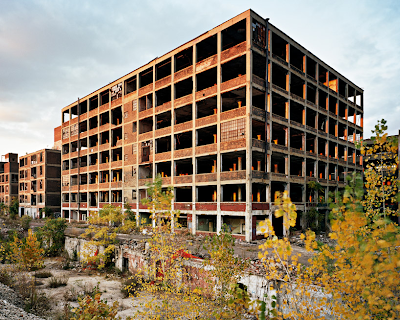
Boom and bust cycles are an inherent part of economies like ours that are based on the consumption of extracted resources like oil. This is one of a number of abandoned plants in Detroit.
Friday, November 6, 2009
Will Allen, Founder of Growing Power, Wins the MacArthur Fellowship
 Like you, I normally don't pay much attention to who wins the MacArthur Fellowship, also known as "the genius award." But in 2008 the $500,000 award went to a Wisconsin resident who is part of the solution to the inherent problems of our commercial food production and food distribution systems.
 Will Allen is the founder and CEO of Growing Power, an organization that produces lots of food year-round on two acres in Milwaukee. Since supermarkets are reluctant to build in our inner-cities, inner city residents are often forced to subside on the highly processed foods they can get at corner stores.
 So Growing Power is doing a great service to inner city residents by making good food available to them.
But I think that those of us who don't live in inner cities would be making a huge mistake to assume that the Growing Power model is not relevant to our own needs. As you may remember, the price of food has gone up over the last few years. It is no coincidence that it went up at the same time that the price of oil skyrocketed.
 As you may have already seen in King Corn, or read in books like The Party's Over, or articles like "Eating Fossil Fuels", commercial food production in our country is largely dependent upon fossil fuels. Oil and natural gas are the main ingredients in the fertilizers and herbicides that the system is based on. Even the seeds are produced by chemical companies like Monsanto. And did you know that the agricultural system as I have just described it is literally ruining the soil of our great land? The American food production system is unsustainable.
 On the other hand, Will Allen and his people at Growing Power work with nature. They grow fish in tanks and the water is cleaned with aquatic plants. Worms consume the garden waste and make it into compost. The greenhouses and hoophouses have multiple levels so that growing space is maximized.
We have more than enough land to start our own community gardens at Moraine Park Technical College. Let's be ahead of the curve and become leaders in sustainability!
Watch a two-minute-plus video of Will Allen based on an interview he did for the MacArthur Foundation after winning their award.
 Read Street Farmer, an article about Will Allen that appeared in the New York Times Magazine.
Visit the Growing Power website.
Tuesday, October 27, 2009
Beyond YouTube: Where to Find Free Documentary Films Online
YouTube is a great website for short videos. Many of them were created by amateurs, and that, of course, is part of the appeal. Nevertheless, there are other sites on the net that aggregate videos, here are three such sites I've found that you can use to access documentary films:
Snagfilms
Snagfilms has a database of over 900 full-length documentaries divided into many categories, including: Indieflix, National Geographic, PBS, Peter Jennings Reporting, and Sundance.
When I first went to Snagfilms they were featuring baseball-related documentaries including one about Bill Lee, formerly of the Red Sox and Expos. The 2006 film follows the 58-year-old barnstorming pitcher to Cuba, where his USA team enjoys several games with the native Cubans. It would probably get an "R" rating for language. Another warning, Bill Lee used drugs in the pre-steroid era.

Watch Spaceman: A Baseball Odyssey
Free Documentaries
 Freedocumentaries.org was founded to give people access to videos that communicate perspectives and opinions that they feel are being unfairly suppressed by the television and film industry. This site includes Spanish and closed captioned videos.
Watch Super Size Me
Watch Merchants of Cool
Watch Wal~Mart: The High Cost of a Low Price
Top Documentary Films
Top Documentary Films claims to be the home of 811 "stunning, eye-opening and interesting documentaries." Choose one that suits your interest through their navigation system, watch it, and leave your comments.
They even have a film about Fond du Lac's own Jeanna Giese, "The Girl Who Survived Rabies." (Unfortunately, an error prevented me from watching this film, hope you'll have better luck.)
Snagfilms
Snagfilms has a database of over 900 full-length documentaries divided into many categories, including: Indieflix, National Geographic, PBS, Peter Jennings Reporting, and Sundance.
When I first went to Snagfilms they were featuring baseball-related documentaries including one about Bill Lee, formerly of the Red Sox and Expos. The 2006 film follows the 58-year-old barnstorming pitcher to Cuba, where his USA team enjoys several games with the native Cubans. It would probably get an "R" rating for language. Another warning, Bill Lee used drugs in the pre-steroid era.

Watch Spaceman: A Baseball Odyssey
Free Documentaries
Freedocumentaries.org was founded to give people access to videos that communicate perspectives and opinions that they feel are being unfairly suppressed by the television and film industry. This site includes Spanish and closed captioned videos.Watch Super Size Me
Watch Merchants of Cool
Watch Wal~Mart: The High Cost of a Low Price
Top Documentary Films
Top Documentary Films claims to be the home of 811 "stunning, eye-opening and interesting documentaries." Choose one that suits your interest through their navigation system, watch it, and leave your comments.
They even have a film about Fond du Lac's own Jeanna Giese, "The Girl Who Survived Rabies." (Unfortunately, an error prevented me from watching this film, hope you'll have better luck.)
Monday, August 24, 2009
King Corn: A Documentary About America's Most-Subsidized Crop
 King Corn is marketed as entertainment. I'm sure it will hold your attention, but it didn't make me laugh. Instead, I think many people can expect to feel outraged while watching this documentary.
Ian Cheney and Curt Ellis (pictured) are just trying to learn how to grow an acre of corn in Iowa. Along the way they also visit a variety of experts on food and agribusiness. If they are outraged themselves, Cheney and Ellis themselves never let on. Instead, they behave like good apprentice farmers, or student-journalists, depending on the situation.
 But it is hard for me to imagine that our two heroes didn't come away from their experiment shaking their heads at the absurdity of modern American agribusiness and hoping that things will soon change. Let me tell you what I'm talking about:
1. All of the Iowa farmers seemed to agree that they're only able to make a living growing corn because it is heavily subsidized by the federal government.
2. The government, however, is not subsidizing the delicious, healthy sweet corn that you might grow in your backyard, instead they're growing varieties of corn that cannot be consumed until they are thoroughly processed.
3. The pesticides used by today's corn farmers will kill every possible plant, even every possible type of corn - except the one that particular pesticide was made to be used on. (Could that possibly be good for the land?)
Okay, so I'm outraged, or at least sad, how about you?
Thursday, August 20, 2009
The Green Building Bottom Line
 In the introduction of The Green Building Bottom Line, Martin Melaver, co-editor of the book and CEO of the construction company Melaver, Inc., noted that no researchers had ever proved that values-based business practices could enhance profits. However, in the process of creating this book, Melaver and his associates were convinced: their investments in "green" practices were paying off not just in the distant future, but much sooner than they would have believed possible.
An Amazon.com customer noted that this book "offers rich detail on creating a sustainability program internally, on green development, on greening existing buildings [and] on sustainability in the market." He also added that it is an easy read full of "tips on how to make things green and where things can go wrong on the way."
Held at the West Bend Campus
Tuesday, June 30, 2009
New Books on Addiction, Food, and the Environment

A History of Food, by Maguelonne Toussaint-Samat. The New York Times raved that this new and expanded version is "indispensible, and endlessly fascinating." The topic is the social history of food. Beautifully illustrated.
 Plan B 3.0: Mobilizing to Save Civilization, by Lester R. Brown. Brown is an "eco-economist." In fact, he's probably the world's most preeminent eco-economist, studying the results of civilization's effect on the environment. The bottom line according to Brown: The business-as-usual path we've been on (Plan A) with regards to the environment is leading us to economic decline and collapse. Brown's Plan B 3.0 will put things on the right track.
 Addiction: A Disorder of Choice, by Gene M. Heyman. In this book, Heyman argues that the conventional wisdom about addiction - that it is a disease, a compulsion beyond conscious control - is wrong. Based on extensive research Heyman makes a powerful case that addiction is voluntary. People (some more than others) have a deep-seated tendency to consume too much of whatever we like the best. That reality has relevance beyond drugs and alcohol in our society today.
Waste Online
 The creation of waste - although it gets much less attention than climate change - is still one of our most serious environmental problem areas. Waste Watch is "the leading environmental charity dedicated to the reduction, reuse and recycling of household waste." Waste Watch oversees Waste Online, a website devoted to educating people about the issue of waste and how to reduce waste at home and at the workplace.
Waste Online is based in the United Kingdom, so not all of the facts it reports are relevant to us in the United States. However, we've always had more space to spread our garbage around, so maybe it is time we learned from the Brits on this issue.
Wednesday, June 17, 2009
PBS Asks: Is Wal-Mart Good For America?
 PBS's Frontline series first aired an excellent installment back in 2004 that is still very relevant and up-to-date. Now available in DVD format, "Is Wal-Mart Good For America?," has a lot to say about the direction our country has been going.
In recent decades, we've lost much of our manufacturing base. Powerful retail outlets, especially Wal-Mart, are largely to blame. But don't take my word for it, watch the video - it is very persuasive. From the time I saw it, I have not made a purchase at that chain of stores.
In case you want to know more about this video, here's something from the back cover:
"Frontline offers two starkly contrasting images: one of empty storefronts in Circleville, Ohio, where the local TV manufacturing plant has closed down; the other - a sea of high rises in the South China boomtown of Shenzhen. The
connection between American job loses and soaring Chinese exports? Wal-Mart. For Wal-Mart, China has become the cheapest, most reliable production platform in the world......."
Available at the FdL campus library (AV collection),
call number HF 5429.215 .U6 I7 2004
length: roughly 60 minutes.
Thursday, February 5, 2009
New Books

The Elephant and the Dragon:
The Rise of India and China and What it Means for All of Usby Robyn Meredith
This book is an "urgent exploration of the earth-tiliting emergence on India and China on the world stage." One Nobel prizewinner in economics calls it an "exciting and journalistic account of one of the great economic stories of our time."

Sacred Cells?
Why Christians should Support Stem Cell Research
by Ted Peters, Karen Lebacqz, and Gaymon Bennett
Is stem cell research ethically (as well as socially and politically) acceptable to people of faith? Yes, say the authors. They know the science involved and bring clarity and depth to the subject.

Billions of Entrepreneurs:
How India and China Are Reshaping Their Futures and Yours
by Trun Khanna
This fun-to-read book offers insights that others have missed. The author tells a fascinating story in an engaging style.
Subscribe to:
Posts (Atom)
