Showing posts with label Alternative Energy. Show all posts

Wednesday, March 2, 2011

Do you Understand Peak Oil?

One hundred years ago, Baku, Azerbaijan was a huge industrial center and one of the most affluent cities in the world. Baku got to that point thanks to its abundant oilfields which produced up to 5000 tons of crude oil per day back then.


The graphic above is something I captured from a 6-part YouTube presentation called Understanding Peak Oil. Clearly they aren't getting 5000 tons of crude per day in Baku anymore, in fact it looks like they completely gave up on drilling altogether.


Understanding Peak Oil makes it clear that what happened in Baku has also happened elsewhere. McCamey Texas, for example:

Above: A picture from McCamey decades ago
Below: The mayor of McCamey, TX today in front of the rusted machinery used during their oil boom.


Much of Venezuela also has that former-oilfield-turned-to-wasteland look:


As I write this, I'm aware that the American economy depends heavily upon oil not just for transporation, but also for agriculture and manufacturing. And the worst thing of all is that we don't have a Plan B ready to go.

Tough times are ahead.

Or are they? Watch Understanding Peak Oil to make up your own mind.

Here's part one of Understanding Peak Oil:

Tuesday, June 22, 2010

A Promise Made by the Last Eight Presidents

Jon Stewart, America's favorite bogus news anchor, recently reviewed a promise that the last eight American presidents have made and not delivered on. That promise, updated last week by our current chief executive, Barack Obama, is to resolve our ongoing energy crisis which has led to inflation, wars, environmental catastrophe, and dependence on foreign nations.


Unfortunately, President Obama's vague statement about "unleashing America's innovation" will not be enough to resolve our worsening crisis (far from it). Instead, every American will have to make a serious effort to consume less energy and less of the things that are made with energy. If that was easy, we would have resolved the issue by now.

Click here to watch Stewart's rant (originally seen on Comedy Central's The Daily Show).

Friday, January 29, 2010

Online Film: Blind Spot

Near the beginning of Blind Spot, Richard Heinberg asks viewers to imagine what it would take to push your car roughly 20 miles. Then he states, "that's what we get for a single gallon of gasoline that we get for maybe two or three dollars." Heinberg's point that we take cheap oil for granted is a reality that was reinforced a couple years ago when a huge amount of complaining went on about how the price of gasoline was over $3 a gallon.

One commenter posted to Snagfilms his belief that Heinberg's scenario was silly because if he didn't have any gasoline he would "just walk." It seemed like a strange and uninformed rebuttal to me.  He completely missed Heinberg's point.


One of the larger points that Blind Spot makes is that in recent decades, we Americans have created an industrial civilization that runs on fossil fuels. That is our infrastructure. And the film also makes it clear that we depend on cheap oil not only for transportation, but also for growing and distributing our food and water. When we produced a lot of our own oil we also used it to manufacture goods. Now, instead, we use oil to import the things we buy from China and other countries

Juxtasposed amongst the footage of interviews with various experts, are American scenes, some rural, some urban, some suburban. Together they serve to reinforce the idea that we've built some enormous structures and enormous vehicles. How well do you think the United States will do when the price of oil goes back up over $100 per barrel?


Above: Even with oil at $70-$80 per barrel, our airlines are struggling.

Below: It is a fact of geology that world oil discovery and production will play out along lines similar to those graphed below for United States oilfields.


The dramatic increase in population over the past 100 or so years could not have happened if not for agricultural and medical practices that require fossil fuels. Although the numbers appear to be rounded off, this graph speaks for itself.


Roscoe Bartlett is not only a Congressman from Maryland, but also an award-winning scientist. He is one Republican who was embarrassed by the "drill, baby, drill" slogan that was promoted by some of the less-insightful members of his party during the 2008 convention. In Blind Spot, Representative Bartlett says that "we will transition [away from fossil fuels]; the question is whether we do it on our timetable or on geology's timetable." I wish that more politicians would speak the truth like that.

Watch Blind Spot now!


Blindspot has a website.

Friday, January 22, 2010

The World Consumption Clock

Below: a sneak peak at part of Lou's World Consumption Clock
Maybe you're familiar with the National Debt Clock. It isn't really a clock, but rather a sign that tells us how much the United States government is in debt.

Lou Grinzo recently created what he calls Lou's Energy and Environmental Clock. To make it simple, you could also call it the world consumption clock. In the few minutes that I've been watching the clock, I've observed the loss of millions of tons of Arctic ice, the consumption of hundreds of thousands of barrels of oil, hundreds of tons of CO2 emissions, and the addition of hundreds of people who will encourage the growth of all the other numbers.

Altogether, Lou's consumption clock is keeping track of seventeen 'fields' of consumption. And for each field numbers are visible for "this session," "today," "this month," and "this year."

I encourage you to check out Lou's clock and also look at his blog: The Cost of Energy: News, Statistics, Commentary, and Activism.

Thursday, January 14, 2010

Renewable Energy Processes

A new book at the Fond du Lac campus will provide all the background needed to gain a thorough understanding of the most popular types of renewable energy - hydrogen, solar, biomass, and wind power. Readable for students but comprehensive and detailed enough for professionals, Fundamentals of Renewable Energy Processes by Aldo Vieira da Rosa doesn't attempt to "describe the 'state of the art' of the technologies involved" because of their rapid advance. Instead, the focus here is on underlying principles that will never lose their relevance.

Includes lots of tables, diagrams and equations.

FdL campus, call number: TJ 163.9 .D3 2009

Wednesday, November 11, 2009

Edward Burtynsky's Photography

Edward "Ted" Burtynsky's photos show us the ugly result of our industrial times. The genius of his work, however, is that, from a visual standpoint, Burtynsky's photos aren't ugly.


A few photos from a series Burtynsky did about oil.

Here's a link to that whole series courtesy of the Corcoran Gallery.


After seeing photos such as this one, I'm surprised that people seem to think that drilling for oil has no harmful effects on the environment.


Relatively cheap oil has allowed us to travel great distances with ease, it has allowed us to live like kings, but, as you can see here, it has also resulted in enormous amounts of waste.


Even the infrastructure that we're currently using doesn't provide us with an efficient use of our time, materials, or energy itself.


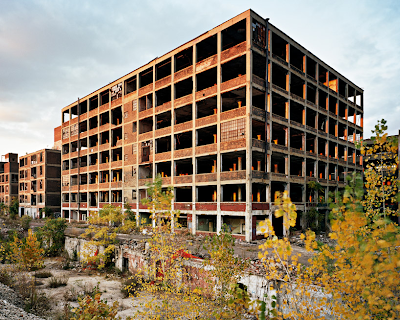
Boom and bust cycles are an inherent part of economies like ours that are based on the consumption of extracted resources like oil. This is one of a number of abandoned plants in Detroit.


*View an e-book of Burtynsky photos.

*Buy his book Oil.

Wednesday, August 5, 2009

CO2 Rising: The World's Greatest Environmental Challenge

If you're having trouble figuring out the chemical and other scientific aspects of global warming, we'd like to recommend CO2 Rising: The World's Greatest Environmental Challenge by Tyler Volk. On the one hand, Volk is a serious and accomplished scientist, but on the other hand, his book is not only readable, but relatively entertaining as science writing goes.

Much of the book involves a carbon atom named Dave, as well as a number of other carbon atoms and the atoms they bond with to form molecules. As the inside jacket states, we follow Dave "into a leaf of barley, then into an alcohol molecule in a glass of beer, through the human bloodstream, and then back into the air."

The knowledge of the carbon cycle that is gained through Dave's biography prepares the reader for a discussion of a number of global warming topics and issues.

Thursday, July 30, 2009

The Party's Over: Oil, War and the Fate of Industrial Societies

The Saudi's have a saying:

My father rode a camel. I drive a car. My son flies a jet airplane. His son will ride a camel.


The Saudis know that oil has made their fortunes and they know that their oil is running out. Maybe that doesn't alarm you, but would you believe that the same is true for us Americans and everybody else?

The Party's Over: Oil, War, and the Fate of Industrial Societies by Richard Heinberg explains (among other things) the huge significance of oil in world history over the past two centuries, and argues convincingly that we're in serious trouble because we are at (or at least near) a worldwide peak in oil production. From this point on, each barrel of oil will be more difficult - more expensive - to drill. At the same time, demand for oil is increasing as China and India are trying to be more like us. Unfortunately, we have only started to invest in renewable energy. According to Heinberg, we haven't done enough to prevent serious crises, but it isn't too late to do things to make those crises less catastrophic.

Use this link to read a review of the book on the Amazon site.

Thursday, April 16, 2009

The Big Energy Gamble


PBS's NOVA recently did a documentary that "explores the pros and cons of California's bold approach [to alternative energy], which could be adopted nationwide during the Obama administration." Here's a link to the companion website. It features interviews, related readings, and more links.

Friday, February 20, 2009

Synthetic Fuels Handbook

Book of the Day: Synthetic Fuels Handbook: Properties, Process, and Performance

Learn both the benefits and trade-offs of synthetic fuels. Traditional fossil fuels are a limited resource. Therefore, the future of our country and the world depends on alternative fuels, including biomass, landfill gas, tar sand bitumen, natural gas and natural gas hydrates, synthesis gas, oil shale, and more. Besides different fuels, alternatives such as fuel cells are also covered.

This McGraw-Hill Handbook was written by James G. Speight.
Includes tables, diagrams, a glossary, appendices, index, and many references.

Location: F Books; Call number: TP 360 .S675 2008

Wednesday, February 4, 2009

Website of the Day: Clean Power

This organization of scientists, environmentalists, public interest advocates, and energy technology companies works to provide "global warming solutions for California and the West" by promoting "sustainable resources and nonpolluting technologies to meet the world's integral appetite for energy." Site features news, blog, reports, project descriptions, and more on topics such as California's climate policies, reducing coal use, and solar and wind energy. From the Center for Energy Efficiency and Renewable Technologies (CEERT).
URL: http://www.ceert.org/
(Blurb borrowed from the Librarians' Internet Index.)