Showing posts with label energy. Show all posts

Friday, March 30, 2012

The National Renewable Energy Laboratory


The National Renewable Energy Laboratory or NREL, has a website with educational material covering all of levels of study. Student resources are available for biomass, hydro, solar and wind power.

The NREL website is loaded with information about renewable energy!

Thursday, February 16, 2012

There's No Tomorrow - A New 34-Minute Film

Do you still think that economic growth and population growth can continue indefinately?


Thursday, November 17, 2011

Galetiva Asks "Whose Job is it Anyway?":

The Association for the Study of Peak Oil, more commonly known as ASPO, had their Truth in Energy Conference earlier this month. One of the speakers was Angelina Galetiva, the founder of Renewables 100, a renewable energy policy institute. Her talk was summarized in a post on the highly esteemed Oil Drum.


As recounted in The Oil Drum, Galetiva ended her talk with a poem of sorts, or maybe we should call it a little fable:


This is a little story about four people named Everybody, Somebody, Anybody, and Nobody.
There was an important job to be done.
Everybody was sure that Somebody would do it.
Anybody could have done it, but Nobody did it.
Somebody got angry because it was Everybody's job.
Everybody thought that Anybody could do it.
But Nobody realized that Everybody wouldn't do it.
It ended up that Everybody blamed Somebody
When Nobody did what Anybody could have done.


The fable speaks for itself, of course.

I've been reducing my consumption of energy, I ride my bicycle to work, heat my home with a pellet stove and now I'm in the process of going solar on a relatively small scale. What are you doing to help with the transition away from fossil fuels?

Wednesday, November 9, 2011

Fossil Fuels are Heavily Subsidized

According to the Bloomberg website, fossil fuels received six times the subsidies that renewable energy received from the governments of the world last year. The article cites the International Energy Agency's report of an increase to an equivalent of $409 billion in subsidies for natural gas, coal and gasoline. This happened despite a 2009 pledge by G20 nations to phase out subsidies for "carbon-based fuels [that are] dug or pumped out of the earth."


Do you know where I'm going with this?


According to the IEA's World Energy Outlook, the subsidy of fossil fuels creates "market distortions that encourage wasteful consumption." And the "costs of subsidies to fossil fuels generally outweight the benefits."

I know that it is hard for politicians to say no to Chevron and BP after they've received such generous campaign contributions, but the world would be a better place if they did so.

Monday, November 8, 2010

Frontline on the Big Spill

PBS's Frontline teamed up with the investigative journalists at Propublica to bring us a 53+ minute documentary on the culture of BP that was certainly a big factor in the oil spill of 2010.


Wednesday, August 4, 2010

Understand Peak Oil in Eight Minutes

While not always using its proper name, I've addressed the startling concept of peak oil before in this blog. In previous posts, I've recommended The Party's Over, sometimes referred to as the quintessential peak oil book, and Blind Spot, a remarkably well-done 86-minute online video that addresses both the seriousness of peak oil and the reasons why people are only beginning to become aware that it is (or will be) a reality.


If you haven't been able to find the time to read The Party's Over, or watch Blind Spot, I'm offering you an eight-minute alternative today. The title, 91•86•90, probably won't grab you, but if you can get past the somewhat monotone narration, this is another well-done online video with a peak oil focus.


Uploaded to YouTube in May of 2009, 91•86•90 was created by investment banker Steven Crowel. If you pay close attention, you'll come away agreeing that peak oil is "a near-term issue that will have profound influences [on our] lives."


Monday, June 28, 2010

Build "Green" with LEED


The US Green Building Council (USGBC) has an internationally recognized green building certification known as LEED (Leadership in Energy and Environmental Design). LEED certification provides third-party verification that "a building or community was designed and built using strategies aimed at improving performance" on some metrics that are very important in terms of environmental impact. Those metrics include energy savings, water efficiency, CO2 emissions reduction, improved indoor environmental quality, and stewardship of resources and sensitivity to their impacts.


Another site, LEED User, provides support for green builders with tips, checklists, sample documentation and a discussion forum.

Tuesday, June 22, 2010

A Promise Made by the Last Eight Presidents

Jon Stewart, America's favorite bogus news anchor, recently reviewed a promise that the last eight American presidents have made and not delivered on. That promise, updated last week by our current chief executive, Barack Obama, is to resolve our ongoing energy crisis which has led to inflation, wars, environmental catastrophe, and dependence on foreign nations.


Unfortunately, President Obama's vague statement about "unleashing America's innovation" will not be enough to resolve our worsening crisis (far from it). Instead, every American will have to make a serious effort to consume less energy and less of the things that are made with energy. If that was easy, we would have resolved the issue by now.

Click here to watch Stewart's rant (originally seen on Comedy Central's The Daily Show).

Wednesday, June 16, 2010

Lloyd's of London: "Bad Times Have Not Yet Hit"

The CEO of British insurance giant Lloyd's has just released a paper which predicts that the economic calamities we've been facing over the last few years are minor when compared to what is coming soon. Our global economy is based on the concept of growth and growth depends on energy, cheap energy to be exact. Therefore, when the paper predicts that the price of oil will soon hit $200 per barrel, the ramifications add up to a lot more than just a higher price at the gas pump.

The author of the document, Dr. Richard Ward, says that the world “has entered a period of deep uncertainty in how we will source energy for power, heat and mobility, and how much we will pay for it."

As Dr. Ward admits, it will be difficult for many people to accept how bad he expects things to get. He acknowledges that the truly "bad times have not yet hit."

On the other hand, those same predictions are nothing new if you've been reading all of my posts over the last few months (perhaps the difference is that this warning comes from business and industry, instead of from scientists, journalists or filmmakers).

Sustainable Energy Security is the title of Dr Ward's paper.

The paper was described on the "Peak Generation" blog.

And, if you haven't read my previous posts about films and other media on this topic, now's your chance to do so:

Online Film: The End of Suburbia

Online Film: Blind Spot

The World Consumption Clock

Edward Burtynsky's Photography

King Corn: A documentary About America's Most Subsidized Crop

The Party's Over: Oil, War, and the Fate of Industrial Societies

Monday, May 10, 2010

The Gulf Spill:Failing to See the Bigger Picture


If you've been following the news lately, you've heard a lot about the oil spill in the Gulf of Mexico. In fact, I heard that BP's own shareholders are trying to sue the company.

Is BP really the evil empire, or is it us? I mean, we're pointing our fingers at a nasty, polluting industry, and at the same time filling our tanks with its nasty, polluting product. Are we playing the blame-game a little too hard with this news story? Are we focusing too much on some kind of technical fix that will "make drilling safe" so we can "get back to normal"?

That may have sounded rather harsh, but we've had other wake-up calls before. They came in various forms, some came in environmental disasters, some in recession-causing price hikes, and one that comes to my mind came in loud and clear from President George W. Bush. He stated that America was addicted to oil (he may have specified foreign oil, but the distinction is not particularly significant in my opinion). I think Mr. Bush was right. We have a problem.

If you still think all the focus should be put on companies like BP, a blogpost by Chris Nedler might change the way you're seeing things. "Another wake-up call for the world’s biggest oil junkie" (that "junkie," of course, is us). Nedler starts out by saying "OK, America, it’s time to get real about energy." I encourage you to read it and decide for yourself.

Monday, March 22, 2010

The Peak Oil Clock

I've discussed peak oil in other posts. (See my post on the online video Blind Spot and also my post about The Party's Over).

Thanks to the people at the Energy and Capital investment newsletter, here is the Peak Oil Clock:


Find out how to invest in energy stocks at EnergyAndCapital.com.


Yeah, that is how many barrels of oil we are using YTD (year-to-date), today, and since you got to this page. Exactly how the number-crunchers at Energy & Capital arrived at March 2nd, 2010 as the peak is something I cannot tell you. (In fact, I question their ability to statistically nail down something as complex as peak oil to a single day.)

Many Americans are behaving (or assuming) that oil is an infinite resource. But it isn't. Let's get ready for a time when the price of gasoline goes way up and less oil is available for manufacturing, for chemical fertilizers and pesticides, and for generating electricity.

Friday, January 29, 2010

Online Film: Blind Spot

Near the beginning of Blind Spot, Richard Heinberg asks viewers to imagine what it would take to push your car roughly 20 miles. Then he states, "that's what we get for a single gallon of gasoline that we get for maybe two or three dollars." Heinberg's point that we take cheap oil for granted is a reality that was reinforced a couple years ago when a huge amount of complaining went on about how the price of gasoline was over $3 a gallon.

One commenter posted to Snagfilms his belief that Heinberg's scenario was silly because if he didn't have any gasoline he would "just walk." It seemed like a strange and uninformed rebuttal to me.  He completely missed Heinberg's point.


One of the larger points that Blind Spot makes is that in recent decades, we Americans have created an industrial civilization that runs on fossil fuels. That is our infrastructure. And the film also makes it clear that we depend on cheap oil not only for transportation, but also for growing and distributing our food and water. When we produced a lot of our own oil we also used it to manufacture goods. Now, instead, we use oil to import the things we buy from China and other countries

Juxtasposed amongst the footage of interviews with various experts, are American scenes, some rural, some urban, some suburban. Together they serve to reinforce the idea that we've built some enormous structures and enormous vehicles. How well do you think the United States will do when the price of oil goes back up over $100 per barrel?


Above: Even with oil at $70-$80 per barrel, our airlines are struggling.

Below: It is a fact of geology that world oil discovery and production will play out along lines similar to those graphed below for United States oilfields.


The dramatic increase in population over the past 100 or so years could not have happened if not for agricultural and medical practices that require fossil fuels. Although the numbers appear to be rounded off, this graph speaks for itself.


Roscoe Bartlett is not only a Congressman from Maryland, but also an award-winning scientist. He is one Republican who was embarrassed by the "drill, baby, drill" slogan that was promoted by some of the less-insightful members of his party during the 2008 convention. In Blind Spot, Representative Bartlett says that "we will transition [away from fossil fuels]; the question is whether we do it on our timetable or on geology's timetable." I wish that more politicians would speak the truth like that.

Watch Blind Spot now!


Blindspot has a website.

Friday, January 22, 2010

The World Consumption Clock

Below: a sneak peak at part of Lou's World Consumption Clock
Maybe you're familiar with the National Debt Clock. It isn't really a clock, but rather a sign that tells us how much the United States government is in debt.

Lou Grinzo recently created what he calls Lou's Energy and Environmental Clock. To make it simple, you could also call it the world consumption clock. In the few minutes that I've been watching the clock, I've observed the loss of millions of tons of Arctic ice, the consumption of hundreds of thousands of barrels of oil, hundreds of tons of CO2 emissions, and the addition of hundreds of people who will encourage the growth of all the other numbers.

Altogether, Lou's consumption clock is keeping track of seventeen 'fields' of consumption. And for each field numbers are visible for "this session," "today," "this month," and "this year."

I encourage you to check out Lou's clock and also look at his blog: The Cost of Energy: News, Statistics, Commentary, and Activism.

Wednesday, November 11, 2009

Edward Burtynsky's Photography

Edward "Ted" Burtynsky's photos show us the ugly result of our industrial times. The genius of his work, however, is that, from a visual standpoint, Burtynsky's photos aren't ugly.


A few photos from a series Burtynsky did about oil.

Here's a link to that whole series courtesy of the Corcoran Gallery.


After seeing photos such as this one, I'm surprised that people seem to think that drilling for oil has no harmful effects on the environment.


Relatively cheap oil has allowed us to travel great distances with ease, it has allowed us to live like kings, but, as you can see here, it has also resulted in enormous amounts of waste.


Even the infrastructure that we're currently using doesn't provide us with an efficient use of our time, materials, or energy itself.


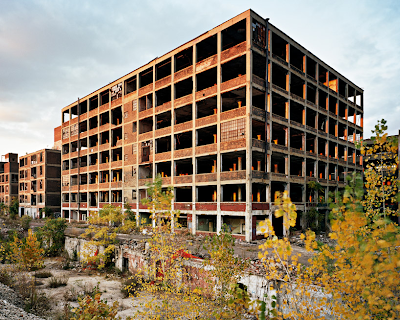
Boom and bust cycles are an inherent part of economies like ours that are based on the consumption of extracted resources like oil. This is one of a number of abandoned plants in Detroit.


*View an e-book of Burtynsky photos.

*Buy his book Oil.

Thursday, July 30, 2009

The Party's Over: Oil, War and the Fate of Industrial Societies

The Saudi's have a saying:

My father rode a camel. I drive a car. My son flies a jet airplane. His son will ride a camel.


The Saudis know that oil has made their fortunes and they know that their oil is running out. Maybe that doesn't alarm you, but would you believe that the same is true for us Americans and everybody else?

The Party's Over: Oil, War, and the Fate of Industrial Societies by Richard Heinberg explains (among other things) the huge significance of oil in world history over the past two centuries, and argues convincingly that we're in serious trouble because we are at (or at least near) a worldwide peak in oil production. From this point on, each barrel of oil will be more difficult - more expensive - to drill. At the same time, demand for oil is increasing as China and India are trying to be more like us. Unfortunately, we have only started to invest in renewable energy. According to Heinberg, we haven't done enough to prevent serious crises, but it isn't too late to do things to make those crises less catastrophic.

Use this link to read a review of the book on the Amazon site.

Friday, February 20, 2009

Synthetic Fuels Handbook

Book of the Day: Synthetic Fuels Handbook: Properties, Process, and Performance

Learn both the benefits and trade-offs of synthetic fuels. Traditional fossil fuels are a limited resource. Therefore, the future of our country and the world depends on alternative fuels, including biomass, landfill gas, tar sand bitumen, natural gas and natural gas hydrates, synthesis gas, oil shale, and more. Besides different fuels, alternatives such as fuel cells are also covered.

This McGraw-Hill Handbook was written by James G. Speight.
Includes tables, diagrams, a glossary, appendices, index, and many references.

Location: F Books; Call number: TP 360 .S675 2008

Thursday, February 19, 2009

Article of the Day: Nuclear Power

The United States and the rest of the world is gearing up for a substantial increase in nuclear power production. This is seen as a good way to stave off global warming, but what other factors and consequences are involved? Click here to read an article from Scientific American

Thursday, February 12, 2009

Web-based Information of the Day

Today's URL is a blogpost from the "Librarian in Black," Sarah Houghton.
http://librarianinblack.typepad.com/librarianinblack/2009/02/sarahs-online-reference-warehouse-energy-saving-resources.html
It's information that you can use:
Her list of energy-saving resources!